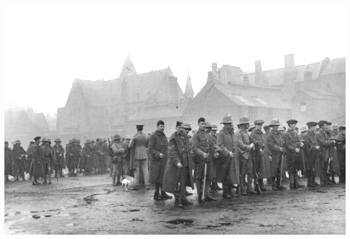
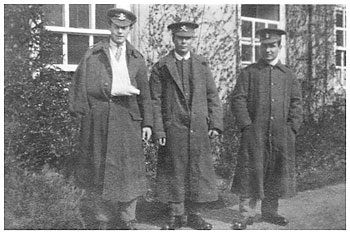
There is little time for rest in war. Early in 1916 the battalion was sent to France, now to become part of the 16th (Irish) Division there. Soon Irish politics were to affect them. To understand why we need to go back a little in time.
In the Summer of 1914, the topic of conversation in political London was not Germany but the prospect of civil war in Ireland. The long campaign for Irish Home Rule had come to a head. Irish Nationalists were promised Home Rule by the Liberal Government. This was fiercely resisted by the Protestant Ascendency of the North, which had been effectively in charge, not only of Protestant Ulster but, also, of the Catholic South. They feared being dominated by those of a religion they regarded as alien.
Under the leadership of Carson the resistance became militant. “Ulster will fight and Ulster will be right”, was the slogan. Arms were acquired and training of a Volunteer Army began. In response, the Catholic Nationalists of the South began to raise a similar force of Volunteers.
Matters climaxed in 1914 with what became known as the Curragh Mutiny. The government in England showed signs that they were prepared to enforce Home Rule and put down any Protestant rising. Now, this was fiercely resented by many officers in the British Army in Ireland – not least by General Gough – many of whom were members of the Protestant Ascendency. They threatened to refuse orders and resign their commissions.
With the outbreak of war with Germany, matters subsided but did not go away. Among Nationalists of the South there was division. The Sinn Fein party saw England’s difficulty as Ireland’s opportunity. They conducted a vigorous campaign against the idea of Irishmen joining the British Army. The numerically larger Parliamentary Party, under John Redmond, took a different view. They were much more sympathetic about the immediate cause of the outbreak of war: the invasion of Belgium, a small nation, like themselves, by Germany. The Redmondites supported enlistment. Since enlistment was then voluntary, it must be supposed that soldiers of the RMF did not take the Sinn Fein view. This did not help them in the future since perception often counts for more than fact.
Just after the arrival of the 1RMF in France, there took place in Dublin The Easter Rising: rebellion against British Rule. To tell truth, it was a bit of a ragbag of a rebellion, organised, or rather disorganised by a mix of dreamers and activists. They took possession of the Dublin Post Office and a bakery and, really, not much more. The rebels were not popular with the inhabitants of Dublin, sometimes finding themselves spat upon by women, who might have men fighting at the front.
The British Army did not have too much difficulty putting down the revolt, bringing in superior force and gunships on the Liffey. Then they made an enormous mistake: they simply shot the ringleaders.
Suddenly, general Irish hostility to the rebels disappeared. They became, and have remained, Irish heroes. This was to have crucial importance in the later struggle for Irish Independence. The connection between events in Dublin and Gallipoli were clear to many Irishmen. The song “The Foggy Foggy Dew” about the Easter Rising contains the lines:
Tis better to die ‘neath an Irish sky Than at Suvla or Sedd-el Bahr.
The Rising had a more immediate effect on the 1st RMF. Within 48 hours, the Germans tried to turn it to propaganda advantage. They put up placards in the trenches opposite them. Under the heading “Brave Munster Fusiliers”, the Times reported that the Munsters responded by singing Irish songs and “Rule Britannia”. A raiding party, many of them said to be wounded, crawled across no-mans-land and seized the obnoxious placards carrying them back in triumph. The battalion war diary was less dramatic. A reconnaissance party had found the placards in an unoccupied German sap and brought them back. They said: “Irishmen! Heavy Uproar in Ireland: English guns are firing at your wives and children! 1st May 1916.”
Attitudes to the Munsters and other Irish regiments were changed by all this, however unfairly. There grew to be suspicion of their loyalty, particularly among the officer class. And among lower ranks: they could now be expected to be greeted with the taunt: “Here come the Sinn Feiners”
The battalion was lucky enough to be in reserve for that terrible day which launched the Battle of the Somme, but they were soon engaged in fighting, significantly alongside the largely Protestant 36th (Ulster) Division. In the Autumn they played a major part in the capture of Guillemont and Ginchy, two German strongpoints that had resisted attack after attack. The week of their capture was notable for fierce fighting in which perished Tom Kettle, Irish Nationalist Member of Parliament, writer friend of James Joyce and a character in many of Joyce’s works. He wrote a beautiful poem for his daughter the night before he was killed.
Know that we fools, now with the foolish dead,
Died not for the flag, nor King, nor Emperor,
But for a dream, born in a herdsman's shed,
And for the secret Scripture of the poor.
Also killed that week was Raymond Asquith, writer son of the British Prime Minister, who also left memorable accounts of life in the trenches.
Also iconic for me is a photograph taken of soldiers of the 16th Division returning from that battle of Ginchy. Tiny details tell an unintended story. The groups of soldiers somehow have a jaunty look, though those nearest the camera carry on their shoulders a stretcher with a wounded soldier. They are passing a dead horse. You notice the hand of the wounded man, holding his forehead. You notice the schoolboy faces of some of the soldiers and that they pay no attention at all to the horse, it is clearly too ordinary a sight. And you notice that the horse, in its moment of deathly fear, has evacuated its bowels.
At Christmas, some relief for the Munsters. There is Leave. Bob Jordan returns to Coventry and he and Elsie Flemming are married. She has gathered together, in her own words, a few sticks of furniture for a home in a room above a shop in Far Gosford Street.
Back to the Front for the Year of Passchendaele. Again it is to be a story of great plans, with little success at great cost. The Haig doctrine of attrition, that ultimately we would be able to stand the casualties better than the Germans, was to be tried again. Soon, for once, the Munsters were about to be lucky in their general.
General Plumer could not have looked less like an effective general if he had tried. Think of an older version of the comic character “Mr Pastry”. The very image of a blimp. But his actions demonstrated complete professional efficiency. The target was to be the Messines Ridge. The battle plan was thoroughly thought out in meticulous detail and rehearsed over and over. Survival, not sacrifice, was part of the thinking and the confidence of the soldiers was won. In the event, in June, an enormous explosion in tunnels dug under the German lines opened the attack, which was completely successful, with low casualties.
Elation did not last. The Messines battle was only a prelude to the main campaign that was about to begin. For this, the 16th Division was to be part of General Gough’s 5th Army and this was unfortunate.
Gough was no impartial observer of Irish politics. In 1914, he had been a leading actor in the Curragh Incident. He had previously reported to the King’s Private Secretary:
The Nationalist Party would not be loyal. … The idea of these disloyal men becoming our rulers was an outrage to very decent feeling I possessed … they would not give us clean government but, instead we would have corruption and graft and probably the country would be inundated with unscrupulous Irish American low class politicians … I could not tolerate the possibility of having a priest-ridden government.
These views would not be without future relevance.
As if timed to coincide with the opening of the attack on the Passchendaele Ridge, the rains came. It rained and it rained. It rained in cataracts such as no one could remember. The 16th were given targets on the Fregenburg Ridge. They had a long march to the battle, were thrown straight in and fought from zero hour till nightfall. But they were thrown back. The corps commander was full of praise for their performance but, yet, they were thrown back.
At first reports of the Great Battle were golden accounts of triumph. Misleading reports sent by Haig encouraged this belief. The Times reported: “Everywhere our objectives were obtained. … The beginning is splendid … The German front line broken ... Casualties remarkably light.”
It was not true; it could hardly have been less true. As this became apparent, blame began to fly and the commanders concerned hastened to revise history. Haig seemed to blame his commanders for being in too much of a hurry and not following his suggestion of waiting for better weather. Gough found a more congenial scapegoat: blame the political unreliability of the 16th for inducing insufficient determination.
There is nothing new in Generals blaming their troops when things go wrong. I can’t help being reminded of an occasion six decades earlier, when John Jordan, then an eighteen-year-old, was flung with the rest of the 57th Regiment of Foot – the original “Diehards” – against strong Russian defences at the Redan, Sevastopol. They were repulsed and there was criticism from Lord Raglan. An observant Colonel took a different view:
The men, I understand did not behave well. But this no doubt arose from mismanagement of the attack and is possibly a good lesson for some of our officers, who always think that British pluck has done and can do, everything. Now British pluck is not absolutely universal. When present it is as good as any pluck, and is in some respects better but without head is worth very little.
To me, Gough’s attitude seems like a case of: “my mind is made up; don’t confuse me with the facts.” For the record, the 16th lost 221 officers and 4064 men in the first 20 days of August. But a sort of whispering campaign against Irish soldiers had begun.
It would be tedious to detail the despondent soldiering of the British Army for the rest of 1917. This was the point at which there set in a kind of hopeless despair in the mud and blood of Passchendaele. Many died of drowning in the shell-holes. The Munsters, with the cold, wet, lice, and rats of Flanders might even have been nostalgic for the parched heat and flies of Gallipoli.
Meanwhile there took place an event that would have profound effects on the soldiers in 1918: The Russian Army collapsed and the October Revolution took Russia out of the War. This allowed the Germans to transfer something like 70 Divisions from the Eastern Front to the Western.
In December the 16th were moved East of Peronne, to what was reckoned a quiet sector.
As 1918 opened, the British High Command realised that the Germans would use the massive new forces for an attack aimed at ending the War before American troops arrived in numbers to change the balance of power, but GHQ misjudged where it would take place. Haig was more concerned about the northern part of the line because of the threat to the Channel Ports. Consequently, in the south, Gough’s 5th Army held 42 miles of front with fewer men than elsewhere. Brigades were reduced from 4 battalions to 3 and those understrength.
To cope with the lack of men, a new theory of war was borrowed from the Germans: Defence in Depth. The Germans had had years to implement the method; the British had only a few weeks.
Briefly, the system relied, since there were insufficient men to man trenches – defence in breadth – on separated strong points, from which cross firing machine guns would destroy attacking troops. Beyond that there would be troops in a battle zones to deal with any breakthrough, and reserves further back.
It may have been a good system, given time, but in practice, projected strong points that appeared on maps did not always exist in reality. Whether the Germans realised how weakly held was this section of the Front is not clear, but it was here that the Germans massed.
As the winter passed, Gough began to be alarmed at signs of activity in front of 5th Army but his concerns were dismissed by GHQ, who said it “was unlikely to be the scene of serious hostile attack.” Gough, in turn, resisted requests from 16th Division officers on the spot for changes to meet the inadequacies. They wanted reserves further forward. Gough refused, saying: “The Germans are not going to break my line.”, a response received with pessimism by the 16th.
The huge assault, which became known as the Kaiserschlacht, was launched on 21st March and aimed with some precision at the point where the 16th were placed. Four weak battalions faced a dozen times as many German battalions.
At 4.30 in the morning, 6000 German guns delivered the heaviest bombardment of the war. With the explosive shells were mixed gas shells: chlorine, mustard, tear gas. The earth trembled with the force of it all.
The total confusion that followed was assisted by heavy fog. Trenches collapsed, wire and strong points flattened. Infantry groped about in gas masks. Horses panicked. Command and control virtually ceased to exist as communication cables were broken by the shellfire. The defenders were deaf, dumb and blind.
When the German Infantry assault began, they found it easy, hidden by the fog, to infiltrate between and surround the strong points and destroy with grenades. Behind them, through the gaps, followed hordes of Germans. Units in the so-called battle zone found themselves cut off and surrounded.
The 1st RMF were lucky that day: they were some way back in Reserve, with 6th Connaught Rangers. A knee jerk order for a counter attack was given. It was a useless, suicidal gesture. Someone at HQ must have realised this for the order was cancelled. The Munsters got the second order in time; the Rangers did not. The result for them was a tragic episode of useless valour.
At GHQ it was thought that the Germans would halt to re-organise the next day. They did not; they swept forward. Many units found themselves cut off and surrounded. Some fought till the ammunition ran out and then were forced to surrender. The Munsters were among those cut off. The Great Retreat had begun.
On the 23rd, Gough ordered retirement behind the Somme and the remaining decimated battalions of the 16th slipped away. They were mixed with vast columns of French civilians, fleeing with whatever possessions they could manage.
Confusion everywhere. The destruction of the Somme bridges was ordered. Mixed groups from different units organised a fighting retreat from behind German lines as best they could. A mixed group of 1st RMF and 6th Rangers, under the command of Lt. Col Feilding, gathered stragglers from other units. They tried several bridges across the Somme without success. Finally they got across by rushing the guards on a bridge occupied by Germans.
With others, they were gathered for hastily organised defence before Amiens. It held and counter attacks began. Feilding was wounded and Guy Nightingale, now a Major, assumed command.
Despite the disorganisation and confusion, the Amiens line held and Foch was put in overall command at a hurried conference of High Command in Doullens. The Germans failed in their attack on 30th March.
After the Retreat, the inevitable blame game began. Gough was sacked. Haig did defend him on grounds of lack of adequate resources but this reason would have reflected badly on the government itself, so it was ignored. The 16th also came in for criticism for lack of determination, not least from Haig. There seems to have been no evidence other than prejudice for this and it flew in the face of German accounts. Nightingale is furious about the criticism:
We owe it all to the Sinn Fein trouble. An Irish division or regiment is mud out here or anywhere and however fine it did there would be all sorts of nasty rumours.
Later he wrote:
I’m glad I’m an Englishman in an Irish regiment, as I can go unprejudiced to those outside fellows and tell them straight that though I’m not an Irishman I would sooner be in an Irish regiment with Irish soldiers behind me in a scrap than any English or Scotch troops they would like to produce.
Nevertheless, what little was left of the 16th Division was disbanded and the remains sent to other Divisions. 1RMF went to 57th Division.
Somewhere in all that confusion Peter Jordan was wounded and he died of wounds on 30th May. The adjoining graves to his are those of a group of Canadians who were killed in a German bombing of a hospital at Doullens that same day. Whether Peter’s death was part of the same incident, I do not know.
The Kaiserschlacht was the Germans last serious throw. They had advanced more than any time since Mons, yet a little mysteriously they were on the verge of collapse. Part may be psychology. Even before March 21st, there were some signs of low morale among the Germans. Even during their advance, there were signs of indiscipline, many getting drunk on French wines and enjoying the stores they found, instead of pressing home the attack on Amiens. For some, knowing of their families close to starvation at home, the relative plenty of the Allies may have created something like hopeless despair. Add to that the prospect of the arrival of unlimited American soldiers and their victory may have had a touch of hollowness.
Twice more, the Germans attacked and failed. In August they were attacked, in turn, in what came to be called the black day of the German Army. From now on they are in general retreat.
The 1st RMF, with the 57th Division are with the first group to break through the Hindenburg Line
Nightingale records it all. Still protesting about the bad treatment of Irish regiments, he also records the steady forward movement:
The Boche is evidently very worried and doesn’t know where he is. He is shelling very unmethodically and mostly with big guns further back than usual... Gerry is gassing us at present, but so wildly and vaguely that it can do no harm.
In September, the crumbling morale of the Germans evidenced by extremely cooperative prisoners: “The prisoners we took this morning said that they were flogged on to the attack last night and ended by shooting their officer.”
But danger is not behind them. Nightingale takes command again when the CO is killed. A much-reduced battalion of 7 officers and 261 men.
By mid-October, they were outside Lille and soon after entered the town as Liberators:
This morning we walked into a city with 125,000 civilians still there, mostly women and all in a high state of excitement! I laughed till I nearly fell off my horse. It was a bit early in the morning and they were not expecting to see any troops, but they were brought from their beds by the sound of our band playing O’Brien Bourru and the Marseillaise! They were laughing and screaming and crying and flinging themselves round the necks of the men and I was very glad that I was on my horse and even then was nearly pulled off several times.
Somehow that recalls the moment they left Coventry, nearly 4 years before. And somehow, after that, all is anti-climax. The Munsters ended the War in Lille and formed the Guard of Honour there for the French President. One of those present for the celebration was Winston Churchill; now back in the Government, as Minister of Munitions.
I have a sort of imagined picture of Nightingale and my father and the very few of those that left Coventry looking at each other emotionally and emotionless.
Kipling has described beautifully the peculiar psychological confusion of the moment when the Armistice was signed on the 11th hour of the11th day of the 11th month:
Men took the news according to their natures. Indurated pessimists, after proving it was a lie, said it would be just an interlude. Others retired into themselves as if they had been shot, or went stiffly about the meticulous execution of some trumpery detail of kit-cleaning. Some turned around and fell asleep then and there; and a few lost all holds for a while. It was the appalling new silence of things that soothed and unsettled them in turn. They did not realise until all sounds of their trade ceased, and the stillness stung their ears as soda water stings the palate, how entirely these had been part of their strained bodies and souls. It felt like falling through into nothing. Listening for what wasn’t there and trying not to shout when you remembered for why.
Nightingale’s account is somehow much more downbeat, almost depressed:
I expect you had a great time when the Armistice was signed. We had a very quiet time. We were in Lille and heard about it at about 9 a.m. Nothing happened. We had parades till 12.30 as usual... There was no excitement in the place we were in... I believe they rang the bells at some of the big churches in Lille, but that was all. Since then we’ve been training harder than ever and have had several inspections by Generals.
The rest is epilogue. With Irish Independence, the Royal Munster Fusiliers were disbanded in 1922. Guy Geddes was one of the small group handing over the Colours at the ceremony at Windsor.
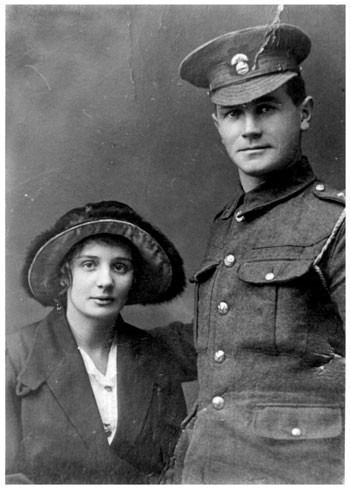
Bob Jordan returned to Coventry, got drunk at the Victory Celebrations and had to be helped home. For the next 27 years, he and Elsie applied themselves to the difficult but more congenial work of raising a family in the harsh economies of the Twenties and Thirties. They lost their eldest son in the Second World War.
There is a curious little incident, which stays in my mind, at the end of that WW2. In the general election of 1945 Winston Churchill came to Coventry, electioneering. He was naturally then at the height of popularity and everyone wanted to see him. Except my father, who said very firmly: “I wouldn’t cross the road to see him.” He was the least political of men and, as a 14-year-old boy, I took this in with silent incomprehension. I did not then know about Gallipoli. Within a month or so Churchill had been defeated by Clement Attlee, one of those who fought at Gallipoli. A few days after that my father died suddenly and, a few days later, the atom bomb was dropped and another War was over.
Guy Nightingale seems to have found difficulty in adapting to Peace. He was still in his twenties and had no experience since school except soldiering. He did bits of soldiering about the world, then retired to Somerset as a half-pay Major. He died at the age of 43, in 1935. There are differing accounts of his death. One, dramatically, says he killed himself with his own service revolver on the twentieth anniversary of the Landing on V Beach. A second obituary suggests a long illness, bravely endured. The death certificate is more prosaic. It gives three causes: cardiac syncope; delirium tremens and chronic alcoholism. “'What is Truth?', said Jesting Pilate, and would not stay for an answer.”
The casualties of war do not all take place on the battlefield. Let the last word go to Maude Nightingale, Guy’s mother. Writing from a Nursing Home in Newbury in 1947 to the former chaplain of the Munsters, she writes:
The mishandling of the RMF broke my Guy’s heart … I am glad you saw Guy’s grave – I shall never cease to miss him. I am 83 now so it will not be long before I see him. I have no family left in England: my daughter, grandchildren and great grandchildren are scattered all over the Empire.
Perhaps not quite the last word. Let that go to the Irish poet, Tom Kettle, who was killed, on the Somme, at Ginchy:
I have seen war and faced Artillery and I know what an outrage it is against simple men.
Paul Smith is a goalkeeper who Southampton signed for £500,000 from Brentford in January 2004. He was signed on the last day of the January transfer window although a power cut nearly prevented the move! For a year he didn't get a game for saints but in January Antti Niemi, the first choice goalkeeper, got injured and Paul Smith got a chance. He put in some decent performances before Niemi returned from injury. A few games later Niemi got injured once again. Smith got another chance and played superbly against Everton, West Brom, Arsenal and Tottenham. After this there was talk of possible England appearances. Now Niemi was back and Southampton manager Harry Redknapp had a dilemma. It was the big match in the Quarter finals of the F A Cup. Saints had been drawn against Manchester United. One of the favourites and the current holders of the Cup. Would he keep the in-form Smith or turn to the experienced and well regarded Niemi. He chose to keep Smith and saints lost rather disappointing 4 - 0. Smith was dropped for the next game against Middlesbrough but Niemi made a mistake in the first half spilling a simple shot and gifting Jimmy-Floyd Hasselbaink a tap-in. But later in the game he made some good saves and saints came out comfortable winners by three goals to one. Although a slightly sad ending for Smith he has built up a excellent reputation and with the ageing Niemi often getting injured Smith is sure to get more chances and is now expected to perform.
|
Olive Baboon |
Chacma Baboon |
|
|
|
|
|
Animal Type |
Mammal - Primate |
Mammal - Primate |
|
Conservation Status |
Lower Risk |
Lower Risk |
|
Distribution |
Eastern Africa |
Southern Africa |
|
Habitat |
Savannah Scrub |
Savannah and City |
|
Predators |
Leopard, Lion, Cheetah and Crocodile |
|
Diet |
Fruit, Eggs, Fish, Monkeys and newborn antelope |
Baboons are social animals and live in large groups called troops. They are often seen with Impala because Baboon and Impala help each other keep safe by teaming up their senses. Despite this alliance Baboons will attempt to catch newborn Impala. Chacma Baboons are very tame. They are pests at the campsites in the wild and at the resorts and attractions in the city. Baboons will steal food from tourists. Baboons spend most of the day on the ground searching for food and playing with other members of the troop. In the night Baboons will go to their sleeping spot in the trees. Baboons have several sleeping spots around there territory and will sleep in the safest one. Chacma Baboons live for about 45 years whilst Olive Baboons live 30 – 45 years.
Even in London, it was clear that nothing would be achievable without greater investment. Reinforcements of fresh, unbattled troops were found and despatched and a new plan hatched. The new strategy involved a landing at Suvla Bay, to cut off the Peninsula in the north. The Munsters, of course would know none of this; they just received the order, at the end of August, to move.
The fresh division, the 10th, were sent first to Mudros. Some of the 29th were resting there. One of the officers of the 10th recorded his impression:
Thus we learned from the men who had been at Gallipoli since they had struggled through the surf and the wire on April 25th the truth as to the nature of the fighting there. They taught us much by their words, but even more by their appearance; for, though fit, they were thin and worn and their eyes carried a weary look that told of the strain they had been through.
The landings at Suvla fell into a familiar pattern, initial success followed by failure, but with a new twist. What was unexpected was that the landings were, in a sense, too easy, against weak Turkish forces. What was then needed was a swift advance to capture the dominating hills beyond the coastal plain. Minds accustomed to the minimal advances of the Western Front could not adjust to this opportunity. Instead of exploiting the situation and advancing rapidly, they dug in against an expected counter-attack, which never came. So the Turks were given time to rush up troops and retain the heights.
The Munsters did not take part in the first weeks of Suvla. They were shipped in on August 21st and launched against Scimitar Hill. Here a new experience of horror awaited them. Shelling had set alight the dry undergrowth and many of the wounded were simply burned alive. Guy Nightingale described this:
We had to lie flat at the bottom of the trench while the flames swept over the top. Luckily both sides didn’t catch simultaneously or I don’t know what might have happened. After the gorse was burnt the smoke nearly asphyxiated us! ... The whole attack was a ghastly failure, they generally are now… Barrett, my old servant, who had only rejoined from hospital a short time ago, is still out there; dead, I hope for his sake, for those who are still alive and wounded must be suffering agonies from thirst and exposure.
Again both sides settled into defensive trench routines.
On 12th September, exactly six months from the inspection at Stretton, Sir Ian Hamilton visited the Munsters. Both Nightingale and Hamilton recorded the occasion. Nightingale:
It was a very different Bn to the one he saw in Egypt last. He was nice and insisted on being shown all the men and officers who had been here since the day of the landing, barely 40 in all, out of 1037.
Hamilton:
Ran across in the motor boat to see the 86th. Brigade. Went man-by-man down the lines of the four battalions – no very long walk either! Shade of Napoleon – say, which would you rather not have, a skeleton Brigade or a Brigade of skeletons? This famous 86th Brigade is a combination. Were I a fat man, I could not bear it, but I am as insubstantial as they themselves. A life insurance office wouldn’t touch us; and yet – they kept on smiling.
As signs of winter appeared, Nightingale grew more gloomy. Then he went down with enteric fever and was evacuated to Alexandria.
In London as in Gallipoli, realisation of the hopeless futility of it all slowly dawned. Hamilton was replaced and the decision to withdraw taken. This was executed with unexpected efficiency.
Fusilier Flynn, of the 1st RMF describes the withdrawal.
When we withdrew on the 20th December it was dark. The soldiers were all packed so tight and quiet in the barges making their way to the big ships. We never lost a man, which was remarkable. As we were steaming quietly away I thought of what ‘Pincher’ Martin, who had done twenty years in the Navy, had said to me a few days after we’d arrived at Suvla Bay: “ We’re not going to be flying the Union Jack here.”
He was right. We were never going to make it ours.
Almost exactly a year after arriving in Coventry, the Munsters arrived back in Egypt.
The campaign cost 114 thousand lives: 66,000 Turks; 28,000; British; 10,000 Anzacs; 10,000 French. And countless wounded.
Bob and Peter Jordan? They survived. In what condition, I do not know. Certainly my father was wounded twice at Gallipoli, and there is a photograph of him in military hospital, possibly at Alexandria. He looks well enough and I guess he was lucky to get acceptable wounds. Peter was less lucky. He was severely wounded; whether at Gallipoli or later, I do not know. He was hospitalised at Clopton House, near Stratford-on-Avon for nearly a year. Mother visited him there and said that half his throat was shot away. Eventually, he was patched up and sent back to the front.
The campaign also cost Winston Churchill his job and he thought his political career was at an end. He protested loudly that his idea had not been tried properly and decided to go into the Army.
He was given command of a battalion. He thought he should have been given command of a Brigade, but got nowhere with his protests and had to cancel the brigadiers uniform he had ordered. For five months he conducted a vigorous campaign to rid his battalion of lice. Then boredom set in and his optimism and his restless ambition revived. He began to think of the possible advantages of resigning his commission and changing his party allegiance. He writes to Clementine, his wife, instructing her to mingle and use her influence in the London political scene.
Perhaps he might have a political future, after all?
News management was more effective than military management. Kitchener allowed only one correspondent with the troops and his reports were heavily censored. Nevertheless, some glimmering of the true state of things must have dawned on some. In Coventry, starting with an account of Jarrett’s “heroic death”, casualty lists were published each week through the year.
Sad stories for those in Earlsdon and Chapelfields. Paddy Long’s brother, Jack: shot down in the water; the bridegroom and best man of January: gone. Sergeant O’Donaghue did not survive to carry his flag to Berlin. Martin O’Malley did die in his new boots. A photograph of ten-year-old Elsie on her bicycle was found in his effects and returned to her family with a covering letter. Most of those who received the mascot were dead, though the Graphic published a cheerful account of how the mascot, Buller, skipped onto V Beach through a hail of bullets and survived unharmed.
Many of the names might convey nothing though, doubtless, there would be sharper mourning in obscure Irish homes.
Reports and photographs regularly appeared of wounded in Alexandria. Later many large houses were converted into convalescent homes for wounded soldiers. There were 23 in Warwickshire.
The War Cabinet would perhaps receive less filtered news of Gallipoli. A “sulphurous” contest of blame game was about to begin in London. Next moves on the Peninsula would depend on decisions taken there.
On the Peninsula, slowing of the pace of battle may have given the soldiers a brief chance to lift their eyes from the battlefield. They would have been all too aware of the military aspects of the landscape: the jagged terrain was as effective as barbed wire in resisting attack. Now, observer after observer commented on the extraordinary colourful and flower-filled beauty of that fresh Spring. The experience was brief.
Fresh Spring moved towards hot Summer. All around were the dead and the smell of death became unforgettably awful, the bodies food for flies. Food could not reach the mouth without clinging flies. The inevitable result was disease, particularly the debilitating dysentery, which the soldiers called the Turkey Trots.
The geography of the place had another unhelpful consequence. Soft limestone meant no water. All water had to be shipped in, so tiny rations of water had to suffice in the dreadful heat.
For the next three months, the war became almost routine, if agony can ever become routine; the smell of death and the sound of shell and bullet almost normality.
Not without incident. On 20th June a private Davis was posted as a flying sentry for two hours. One and a half hours later, when the sergeant checked, he was missing. He reported back to the guardroom three hours later. No field officer being available for his court martial, 2 majors and Guy Nightingale formed the court. Davis claimed that he had continued his duty till two o’clock, when he was struck by severe stomach pains and had to find a latrine, where he remained for two hours. He was disbelieved and, having a bad previous record, was executed. Nightingale appears to have had no qualms about this verdict, arguing that such conduct endangered other men.
At the end of June, Hunter-Weston ordered yet another attack to try and take Krithia. As so often, it began well; as so often, it faded against determined Turkish defenders and relentless machine guns. By the end of July, only three officers remained of the 26 who had landed in April and 314 other ranks, half of whom had returned after treatment for wounds.
Where it lives.
The Cape or African Buffalo is a large mammal and the only type of cow adapted to the African savannah. Herds vary from 10 to about 2000 in areas such as the Okovango Delta where they are migratory. Buffalo do not really have any predators, Lions and Crocodiles will attack weak or old members of herds. Old bulls often leave herds to become solitary and they are the most often preyed upon. Buffalo can be dangerous and often stampede towards predators. Buffalo kill the young of their predators and many adult animals are also killed. Buffalo wallow to help keep cool and remove fleas. Buffalo are normally seen with oxpecker birds, Buffalo’s best friend, which also help remove fleas and ticks.
Darkness brought some relief: the gunfire faded; the wounded could be moved, defensive trenches dug, gaps cut through the wire. Guy Nightingale, young and inexperienced, was now effectively in command on the beach. They buried Major Jarrett and spent a cold, wet night dug in under the cliff.
The Turks were also weakened and in difficulty, but still able to defend fiercely, though not strong enough to throw the invaders into the sea.
By the morning of the 26th, Lt-Col Doughty-Wylie was sent ashore and a plan was devised for a double attack through the Fort and from both sides of the village of Sedd-el-Bahr. The remnants of Munsters, Dubliners and Hampshires were now combined into one unit, known as the “Dubsters”. These took the fortress with a bayonet charge and moved on into the village.
The village was a formidable problem. Destroyed by the naval bombardment, it still offered concealment for snipers, and it took several hours to clear. Eighty Turks were killed and twice that number of British.
Beyond the village, the target was Hill 141, which was taken by bayonet charge. Nightingale describes the attack.
My company led the attack with the Dublins and we had a great time. We saw the enemy, which was the chief thing and all the men shouted and enjoyed it tremendously. It was a relief after all that appalling sniping. We rushed straight to the top and turned 2000 Turks off the redoubt and poured lead into them at about 10 yards range. Nearly all the officers had been killed or wounded by now. A Colonel Doughty-Wylie who led the whole attack was killed at my side. I wrote in about him to the staff and he has been recommended for a VC. I buried him that evening and got our Padre to read the service over him.
Seven months later, an unknown woman visited the grave of Doughty-Wylie. His wife, probably; his lover, possibly.
The very day that he was killed there was a letter from Winston Churchill in the Times:
A voice had become audible, a note had been struck, more true, more thrilling, more able to do justice to the nobility of our youth in arms engaged in this present war, than any other.
That night, the Turks made a couple of attempts to retake the hill, but were held off. In the morning, the Dubsters were relieved by newly arrived French troops and returned to V Beach, where they breakfasted and tried to sleep on the hot beach among the dead.
Not for long. In the afternoon, they were moved to a new position ready for a battle planned for the next day, which became known as the First Battle of Krithia. Hunter-Weston’s plan for this was more ambitious than effective. Little progress was made; casualties were high: a dismal shambles of a battle, all to no point.
On the night of May 1st, the Dubsters were attacked by a silent mass of Turks, creeping up through the gorse and bayoneting the men in their sleep. After five hours of hand-to-hand fighting, resisting charge after charge by the Turks, the Turks were driven off.
Gradually, the fighting diminished, as both sides began to recognise the expensive futility of attack. Bodies were everywhere. Nightingale records digging in one night and finding in the morning that he had dug in next to the remains of an officer of the K.O.S.B. who he had last seen at the Opera in Malta.
The stalemate began to resemble that on the Western Front, to avoid which had been the entire purpose of the Gallipoli Campaign.
Geddes returned from treatment, now promoted to command of the entire battalion. Nightingale comments: “Geddes is a ripping commanding officer to work with but he is frightfully worried and his hair is nearly white! I have never seen fellows get old so quickly.”
There is a photograph of the Munsters on parade, taken by Guy Nightingale 18 days after the landing. 5 officers and 372 other ranks, from the 26 and 1002 who set out from Coventry. Two men, side by side, wear the new flat caps rather than the tropical helmets of Burma. My sister and I both believe we can recognise our father by his stance and believe the other must be Peter.
Nightingale was sent a copy of the Times in May. He complained vigorously about the way the news is softened, with news of casualties dribbled out gently to avoid alarm at home. “I suppose they’ll try to make out it’s been nothing at all out here, just a scrap with the Turks whereas it’s been hell and frightfully mismanaged.”
"A record made from nothing but other records?" writes Frank Broughton on his djhistory.com site. The innovations that this record introduced have become so commonplace that it almost sounds clichéd: the Good Times riff, the scratching and 'found' recordings. But try to imagine this crackling from the speakers in 1981. This is where it started baby-boy!
We were used to dancing the simple, knees-bend, white-boy skank of Two-Tone, and along comes this record where half the music isn't there at all. Eventually, you discovered you could dance through the breaks. The beat (ahem) goes on.
I've always believed the "Why don't you tell me a story?" section comes from a Danny Kaye film, but scouring the Internet I find no justification for this belief. Answers on a post-card, please.
Finally, this record is a tribute to John Peel, inevitably the only person who would play it on the radio. Like so many other landmark records of that period, it was featured nightly over a period of a week or two, mingled with boring bands from Belgium, until it got so deep into you, you just had to go out and buy it. After John died I was limp with grief for weeks.
The Adventures of Grandmaster Flash on the Wheels of Steel. Buy it here
If you own the copyright for this track and would like me to remove it, please drop us a line, and I'll remove it right away.
A hoarder, me; I have a cupboard filled with about 500 LPs and probably an equal number of 7" and 12" singles. Caroline is constantly telling me they are an anchor, mooring us in the dock of clutter. And I sympathise. I loved a story I read the other day on a Zen Buddhist site, about the man who limits himself to 600 possessions — each time he receives a gift or acquires something new, he selects an item to give away.
As pleasing as this idea is, I cling to my vinyl like a comfort blanket. Belying the rock journo cliché that pop music is "disposable", this stuff is no more disposable than a family photo album. Though I get shirty with those guests on Desert Island Discs, whose collections seem to represent only memories — as if what's in the grooves counted for nothing — it's undeniable that these records are stamped with their context: favourite record shops, pocket money and student grants, bargain bins, favourable reviews in the NME or radio plays.
[As I write, I'm conscious this talk of grooves and record shops casts me in the archaic mould of my grandparents with their wireless and stereogram, but bear with me young reader; you'll be here sooner than you think, with your cherished memories of the shiny silver disc!]
The last LP I bought was Neil Young's Freedom, and the first CDs included Kate Bush - The Sensual World and Rei Momo by David Byrne. So we must have graduated to CD around October '89. A strange boy, I moved backward through recorded history as easily as forward, and so reckon my earliest is a November 1933 release of Your Mother's Son-In-Law by Billie Holiday. A fifty-odd year slice of recorded music.
Inspired by the lovely Eclectic Boogaloo I have resolved to sweat this asset. J-M.org will unleash choice cuts into the blogosphere under the usual ethical-if-not-quite-legal guidelines. If you like the music, buy it (unless it's deleted, in which case tough luck mr. music mogul). MP3s will be removed after a limited airing of a week or two.
And the most delightful part of this plan is that it allows me to use a cheesy pun. Welcome to The Vinyl Countdown. Now read on...
African Leopard

Where Leopards live
Despite the being 500,000 Leopards in Africa seeing a Leopard is amazingly hard. Leopards are among the most secretive animals in the world and are most active at night. They spend the day lying in thick areas of bush or in trees. Leopards enjoy Boabab, Umbrella Thorn Acacia and Fig trees.
The Munsters arrived at the harbour of Mudros, on the island of Lemnos, on the 10th of April. They looked with awe at the great armada of ships assembled there: French and Russian as well as British. Among the black ships there moved strangely rigged Greek boats, with peasant food for sale: meat and fish and wine.
They were at Mudros for two weeks – longer than expected because of unsettled weather, unsuitable for the planned landings. Time for more training and practice for what was expected to come.
Hamilton had done what he could, with what he had, to plan the landings, but what he had was little enough. Above all he lacked time. In the day or two available before leaving London, he had gathered a tourist book and a map. That map, somehow, symbolises the core problem of the entire campaign. It was drawn up sixty years before, for the Crimean War. The contours are few and far apart, no detail, deeply misleading. Now, for skilled map-readers, contours tell the story: contours far apart tell of a gentle terrain, easy for an army to stroll over, exactly opposite the reality of the jagged resistance offered by the actual landscape. In London, details of geography would not matter. Reality was different. The devil is in the detail.
Hamilton’s plan called for diversionary attacks on the Asian shore of the Dardenelles; for landings by the Anzacs in the north of the peninsula and for five landings: S, V, W, X, and Y around the southern tip.
On Friday, the 23rd of April, the weather cleared, and ship after ship, crammed with soldiers, began to move out of Mudros harbour. Geddes recorded that at 5.30 P.M. on that day the Munsters left for the great adventure. A perfect evening, he says, with solemnity and grandeur, cheering from the crews and bands playing.
But, he says:
What struck me most forcibly was the demeanour of our own men, from whom, not a sound, and this from the light hearted, devil-may-care men from the South of Ireland. Even they were filled with a sense of something impending which was quite beyond their ken.
Doubtless men were immersed in personal thoughts. One such was Lt. Col Doughty-Wylie. At home, two women, his wife and Gertrude Bell, his lover, had indicated that they might commit suicide if he were killed. He writes to Gertrude from the Clyde:
When I asked for this ship, my joy in it was half strangled by that you said, I can’t even name it or talk about it. As we go steaming in under the port guns in our rotten old collier, shall I think about it… Don’t do it. Time is nothing, we join up again, but to hurry the pace is unworthy of us all.
Now, the story of those landings has been told many times, not least by John Masefield, later to become poet laureate. But, it has to be said, that he was sent to report on the campaign with propagandist intent – and it shows. All is bathed in an effulgent, patriotic glow. Describing the departure of the ships, he writes of:
... the beauty and the exultation of the youth upon them like sacred things as they moved away … All that they felt was a gladness of exultation that their young courage was to be used … Till all the life in the harbour was giving thanks that it could go to death rejoicing. All was beautiful in that gladness of men about to die, but the most moving thing was the greatness of their generous hearts.
The next day the Munsters were taken aboard the River Clyde. Geddes was lucky to be given hot chocolate and a shake down on his cabin floor by Commander Josiah Wedgwood, socialist M.P. and Navy Volunteer Reserve Officer. He had a pleasant night’s rest.
Beautiful dawn on the 25th, a slight haze but not a breath of wind. The day of the landings had arrived.
Now, some landings were to be much harder than others. None were picnics and, in particular, the exploits of the Lancashire Fusiliers, on W Beach, have been properly acclaimed. But there can be no doubt that those on board the River Clyde drew the short straw. Masefield described the landing on V beach as the worst and bloodiest of all the landings.
Commander Unwin’s plan for the assault was clever and ingenious, but would it work? The River Clyde, an old collier, was his Trojan Horse. Armoured cars, in sandbagged emplacements, were strapped on deck to provide gun cover. Ports had been cut in her sides from which the men would emerge and gangways built out for them to run down. The Clyde was to be beached as near to the shore as possible and a string of lighters, barge-like vessels, which she towed, would form a bridge to the shore.
At the same time, other vessels, with most of 1st Dublins aboard would be towed fairly close inshore and row the rest of the way.
On board the Clyde were the four companies of Munsters, two of 1st Hampshires and one of 1st Dublins. About 2100 men.
So far, so neat.
V Beach was a narrow crescent, about 300 yards across, a natural amphitheatre: on the left, steep cliffs about fifty feet high, say twice the height of an average house; on the right, an old Fort; beyond that, the village of Sedd-el Bahr. Little cover for those landing; natural defences for the Turks. And Liman Von Sanders and the Turks had used their time effectively. Well-concealed trenches and formidable barbed wire – under the water as well as on the beach.
At 0500 the naval bombardment began. Churchill had used the power of the naval guns as an argument in pressing the merits of the campaign. He was wrong. The low trajectory of naval guns, compared to the dropping arc of land artillery, was less effective. The Turks were well spread out and little disturbed. They were disciplined, held their fire, and waited. They were not numerous; they did not need to be. Four machine guns, well placed, and a few score rifles, would be ample.
At 6.25 the River Clyde beached, with no jar. As she did so, the boats of the Dubliners came in alongside. They were met with a violent fury of rifle and machine gun fire. Geddes and Tizard saw the carnage with horrified apprehension. Slaughtered like rats in a trap, said Geddes. Many were killed or wounded in the boats; some were knocked into the water and tried to get a little protection by clinging to the sides of the boats; some tried to make it, up to their necks in the water; many drowned; some came back to rescue a mate, only to lose their own lives. A Navy flier saw the water, red with blood, for fifty yards from shore.
A few made it to the shore and found protection behind a small bank of sand.
Then the turn of the Munsters. X company, under Captain Geddes, on the port side; Z company, under Captain Henderson, on the starboard; Y company under Major Jarrett in support; W company, under Major Hutchinson, in reserve, on the River Clyde.
But first there were problems to be cleared up. The steam hopper towing the bridge of barges broke away, or got shot away, and the barges finished crossways in front of the Clyde. They were pulled back into place, under murderous fire, by Unwin and naval crew-members, with help from Fusiliers.
So Tizard now gave the order to disembark. Now, said Geddes: “we got it like anything, man after man behind me was shot down, but they never wavered.”
Knowing the exact point where the men were going to emerge, the Turks had a fixed and easy target. Someone counted the first 48 men to follow Geddes: all fell. Lieut. O’Sullivan, the bridegroom of January, fell. His best man, Lieut. Watts, wounded in five places, cheered the men on with cries of “follow the Captain”.
The barges gave trouble again, drifting in the strong current. Geddes, finding himself alone, had to jump into the sea and swim ashore. Many others who tried this drowned because of the great weight they were carrying: 84 lbs; full pack, 250 rounds of ammunition; 3 days rations.
Henderson’s company on the starboard side fared no better; Henderson himself was badly hit. He died from his wounds later.
The lighters became piled with dead and wounded; those following had to run over heaped bodies. Few, very few, made it to the shore and the protection of that little bank of sand. The landing was repulsed and the Turkish fire ceased at about 0800. There was, for a while, silence.
With a Sergeant and six men, Geddes tried to secure the right of the beach and get some sort of lodgement in the Fort but three were killed and he, himself, wounded
At about 0900, Tizard tried again, sending Major Jarrett and some of Y company. There was a spit of rock, which looked like a good spot to head for, but the enemy had got its range nicely, and it was a death trap. Few made it to the sheltering sandbank.
Hunter-Weston, divisional commander, had concentrated all his attention on W beach, to the complete exclusion of all other landings. Opposition there had been overcome. Hamilton, from his vantage point at sea, was aware of the problems on V beach and could see the advantage of diverting troops to W Beach. With his usual diffidence and unwillingness to interfere, he made this a question to Hunter-Weston, rather than an order, and it was ignored.
Later, Tizard, on the Clyde, spotted men from the next beach on the cliffs to his left. He sent a message to Divisional HQ, asking that they be used to outflank the Turkish defences. His message was ignored. Later came an order to continue with the landings, so Tizard unwillingly sent another company of Hampshires. Again the barge closest to the shore had become detached, so the Hampshires were halted. General Napier and his brigade major went to investigate and both were killed by shellfire. Nightingale watched Napier die.
Guy Nightingale was sent to join Jarrett’s company. He managed to get through the sea despite the bullets. Jarrett sent him back to the Clyde to advise Tizard not to send more men in daylight. Tizard took this advice, despite Hunter-Weston’s order.
Nightingale went back to the beach. Jarrett and he organised the few unwounded to set up some sort of defence. Jarrett was killed; Geddes was, by now, suffering too badly from wounds to do much. So the day passed, somehow, with cries of wounded under the searing sun.
At about 1700, it grew dark. The remainder of the troops on the Clyde could now get ashore safely. Geddes was evacuated to the Clyde and taken aboard a hospital boat next morning.
Tizard said that before the landing it had been surmised “that by 8 a.m. the ground above the beaches would have been won; by noon we should be in the vicinity of the village of Krithia, and have taken the Hill of Achi Baba that night.” These objectives were never reached in the eight months of the Gallipoli campaign.
Night would bring no rest for the survivors. At midnight, Hunter-Weston ordered that the advance should be continued.