February 27, 2005

South Africa photos finally complete

Posted at 18:35 by rob in Rob , Travel | | Comments (0)

Yes, at long last, I have completed editing our holiday photographs from South Africa (that's right, our holiday in October/November last year!) You can view them here.

February 21, 2005

Gallipoli 3: To War

Posted at 20:51 by tony in Gallipoli , Tony | Trackbacks (119) | Comments (0)

The departure of the Munsters from Coventry was a tumultuous and emotional affair. It was meant to be a dignified march to the station but the good citizens of Coventry would have none of it. These sons of Ireland had been adopted as their sons, their lovers. Children weaved their way in and out of the marching ranks, women hung round the necks of soldiers. The police tried to control things, but were no match for the high emotion of the people.

Through the night, there continued the tears and embraces. Three trains came, and went, carrying away their cargo of men. Until, in the cold dawn, there was nothing but silence. And waiting.

The progress of the troops would now be recorded by officers of the battalion. Twenty-six officers, a chaplain, and one thousand and two other ranks left Coventry. Three in particular engage our attention because of the records they left. As it happens, two of these were named Guy.

The name you will see on the monument is that of Colonel Tizard, battalion commander. Now, by chance, I once met the Colonel, at a memorial service, fifty years after Gallipoli. To me he did not seem especially prepossessing – a little, as I recall, like Captain Mainwaring, in the television series, “Dad’s Army”. I did not suspect then, what I suspect now, that I might owe my very existence to one of his unspectacular decisions. As battalion Colonel, he would be placed at HQ, not as close to the action as the junior officers.

Captain Guy Geddes was closer to the action than any human being would wish to be. He may have been a New Zealander, though I am not sure. There is a terse, sharp and direct, quality to his comments. He describes himself as not having the pluck of a louse, a phrase that seems a favourite with him. In fact, the record shows just the opposite: he demonstrated both outstanding physical bravery and moral courage.

Lieutenant Guy Warneford Nightingale was a much more complex character. He was born in India, the son of an English engineer at the time of the Raj and was sent home to be educated here, at Rugby. It was a definite part of his intention that he should put on record the activities of the battalion, as part of regimental history. He put these accounts in the form of diaries and letters to his mother and, sometimes, to his sister. Since he was responsible for censoring his own letters, these are more open than might otherwise have been the case.

His mother, Maude Nightingale, was an interesting character in her own right. She was born a Warneford, one of those long established County families – in her case, in Berkshire – and there were connections to India and Warwickshire. Some will recall the Warneford Hospital. Maude wrote a charming and lively account of growing up in Victorian England and India, where she was presented at Court to the Governor.

The day following departure from Coventry, the Munsters sailed from Avonmouth in the Anson and Alaunia. There was a submarine alert on the way out, but otherwise, days of lovely sailing by way of the Bay of Biscay through the Straits of Gibraltar to Malta, where they spent a day or two. I don’t know whether Bob and Peter Jordan realised that they were treading ground that their father had trodden before them: he spent two years in Malta between The Crimea and the Indian Mutiny.

Then they were diverted to Alexandria. The reason for this was that the rushed organisation had resulted in the boats being mis-packed, the equipment needed first buried beneath other stuff. “A pretty fair state of chaos” was Geddes comment.

In a way, this comment might be seen as the first of many criticisms of the organisation of the Gallipoli Campaign. It is, I suppose, normal that many seek a share of the praise in the case of victory and seek to divert blame for failure. Retrospectively, the Gallipoli Campaign has been often praised for the brilliance of the strategic vision and the dismal quality of the application. There has been much blame of individuals. In some ways, this is just; in others, grossly unfair. Much of the blame should attach to culture and the climate of social expectations.

I think of a significant moment when Hamilton was appointed by Kitchener to command, the very day that the 29th were inspected by the King, rather late in the day you might think. There was a short pause, when, it seemed, the diffident and gentlemanly Hamilton expected guidance on how to carry out his task. There was none. The problems were his. Diffidence, a lack of will to impose control on his generals is seen as the key weakness of Hamilton.

Only two days before that, Hunter-Weston had been appointed. His characteristics were the very opposite of those criticised in Hamilton. He was to be criticised not without cause, for butchery, the unthinking disregard for casualties. Somewhere, implanted in his mind, was the unquestioned slogan: “casualties do not matter, if the military objectives are obtained.” This was held to be the logic of war. Both were, in their way, victims of hierarchical structures, where the man at the top has the vision, those below have to deal with the awkward details. Those who criticise the vision cannot expect enhanced career advancement. Understanding of their implicit roles was almost bred in the bone. Inadequacy may seem a feeble defence; it may be a true explanation.

Churchill, too, would not, could not, question his role. He belonged to a long aristocratic line. Look at the great gardens of England, and you may see what I mean.
It is for the aristocrat to display the vision; for the labourer to wield the spade. But, if the detail is left to others, the devil may find his way in.

Such thoughts aside, it would be interesting to read the minds of the soldiers as they sailed into Alexandria. I guess the men would explore for what sources of interest and pleasure they might discover. Geddes recorded strolls in the town with Jarrett and Henderson. Guy Nightingale cried off with ‘flu. There was tennis and tea at the club. There were also military exercises at Camp Mex: Geddes says the men performed splendidly.

For some, Alexandria may have held a special interest. Many, if not most, of the officers had received a classical education and may have remembered the special place of Alexandria in the Ancient World. It was the meeting place of East and West, the meeting place of Greek and Roman civilisations. While Athens remained the centre of philosophy, of Plato and Aristotle, Alexandria became the centre for Science, of mathematics, astronomy, biology and medicine, the home of Euclid and Archimedes.

All this was symbolised by the great Library of Alexandria, built by the Ptolemies in 290BC. Here was collected all the accumulated knowledge at that time. The circumference of the world was first calculated here, the stars were first mapped, the power of steam was discovered.

Here too, Cleopatra practiced the political use of sex to preserve Egypt from Roman rule. In the process, she bore Julius Caesar a son, and Mark Antony three children, all coincidentally to great political advantage. Ultimately, all to no avail. Defeated, with Antony, at Actium, she preferred suicide by poisonous asp to the indignities of defeat. The great library was then burned down by Augustus Caesar. It held too much knowledge that was offensive to too many people.

Little was all this to do with the soldiers of the Fusiliers, except for one significant matter. One person at least remembered something of a classical education. On the coast of the Dardanelles Straits, opposite to where they were to invade, was the site of Ancient Troy, where Greeks defeated Trojans by means of the deceptive gift of a Wooden Horse containing soldiers. Commander Unwin of the Navy saw that this idea could be adapted to modern needs. A “wreck ship” could be adapted to become what we now know as a landing craft for landing soldiers on the shores of Gallipoli.

The idea was clever and ingenious. But was it wild and impractical?

Twenty-four days after leaving Coventry, the Munsters departed Alexandria, en route for the Greek Islands, in the Anchor Line ship Caledonia. Their stay in Egypt had advertised their intentions. Von Sanders and the Turks were given good advanced warning. They would use this time well.

February 15, 2005

Gallipoli 2: Royal Munster Fusiliers in Coventry

Posted at 1:40 by tony in Gallipoli , Tony | Trackbacks (121) | Comments (0)

From the East, the 1st Battalion Munster Fusiliers left Rangoon in December 1914. From the West, two young men in their twenties – my father Robert Jordan and his brother Peter – left New York to join up with them.

John JordanThe connection between these two events goes back to my Grandfather, John Jordan. Born in 1836 in County Limerick, Ireland, John Jordan lived in interesting times. He was a child of nine when the Irish Potato Famine began, but survived when millions died. Many are the tales of horror from those years but, for some reason, one small story stays in my mind. The Relieving Officer from John’s town was passing a churchyard at dusk and saw a figure among the graves. Fearing some desecration, he crept in and found an emaciated woman. “What are you doing here?” he asked. “Oh sir”, said she, “my children are starving and the nettles do be growing here so nicely, I pick them at night unnoticed.”

At the age of 17 years and 10 months, John Jordan enlisted with the 57th regiment of Foot at Tralee, and saw service with them in the Crimea, where he was present to observe the Charge of the Light Brigade and to take part in the capture of Sevastopol. Later, he was in India at the time of the Indian Mutiny and in New Zealand for the Maori Wars.

Marrying late, he still managed to produce 19 children with two wives. Leaving the Army and returning to Ireland, he was recruiting Sergeant for the Munsters. On his death, in 1906, the family emigrated, two by two, to America.

Many of the soldiers returning from Burma would have been recruited by him, as were at least four of own sons, including the two now rejoining their old regiment.

It puzzles me to know what motivated them to do so. I suspect that, if I had been safely settled in America, I would have needed some persuasion before putting my head in the fire. There is irony in the affair because, sixty years before, John Jordan had passed through the Dardanelles to the Crimea to help the Turks and prevent the Russians getting access to the Mediterranean. Now, two of his sons would be going there to fight the Turks in order to preserve Russian access.

pool-meadow-350.jpgThere is a photograph of the Munsters on Pool Meadow, waiting to be billeted around the city, when they arrived in Coventry on 11th January 1915. Truth to tell, they look a pretty raggedy lot, with a strange mixture of uniforms: some in tropical kit, with pith helmets; some in new uniforms; a few looking particularly bedraggled. I suspect that the latter might be survivors from the sister battalion, 2nd Munsters, which had been virtually wiped out when forming the rearguard at Etreux in the Retreat from Mons.

On the very day the picture was taken, Admiral Cardan presented his plan for the naval assault on the Dardanelles to the War Cabinet. Already, fatal flaws in the higher strategy were beginning to show: the Navy assumed that this would be no more than a demonstration that could be broken off at any time, leaving the Army to finish the job; the Army expected only to be a reserve to assist a Naval operation.

The soldiers in Coventry, of course, knew nothing of the rhetoric and delusions of politicians and the higher military in London. There, the determined optimism of Churchill confronted the doubtful pessimism, or realism, according to point of view, of Jackie Fisher and the more complex reservations of Kitchener. Churchill said: “what an excellent thing it is to have an optimist at the front.” Prime Minister Asquith said: “ Excellent, provided you also have, as we have in Kitchener, a pessimist in the rear.”

Even had they known all, the soldiers would not and could not have done other than they did. For them, one option only, the ageless tactic of the powerless: imitate the action of the ostrich; what cannot be cured must be endured; seek pleasure today, for tomorrow we die. Seek warmth.

All accounts of the Munster’s stay in Coventry agree that they won and warmed the hearts of Coventrians with their humour and geniality. If you have ever visited the West of Ireland, you will recognise this extraordinary warmth and openness. Even seventy years later, elderly Coventrians, writing to the local paper, recalled this. Warmth met warmth.

But, if the people were warm, the climate certainly wasn’t. These troops were transported suddenly from tropical summer to bitterly cold and bleak English January. Their light clothes were not suitable and one account says they were dropping in the street with ague. One reputed remedy was the cheap whiskey of those days with, at times, predictably unfortunate results. One story describes them as big, rough fellows, always ready for a scrap, and tells of a particular incident when a drunken soldier insulted a lady in a chip shop on the Radford Road. An officer was called to investigate.

“Paddy “, he said, “You are a damned nuisance and a sloppy soldier and this time you are going to get it.” Then he knocked the soldier into the gutter with a left and a right. Two soldiers were then ordered to frogmarch the offender back to barracks.

Other sources of warmth were sought. Most of the troops were billeted in Earlsdon or Chapelfields and practised their shooting at the Butts. Now, these were young men, with young men’s urgencies. Coventry was not short of attractive young women, many working nearby at Rotherhams watch factory. Unsurprisingly, there were mutual attractions. Some later resulted in marriages. William (Paddy) Long, one of two brothers from Glanworth in County Cork, was billeted with the Allen family in Lord St., Chapelfields and soon began courting the eldest of their three daughters. He came back from the War to marry her and raise a family in Coventry, working for years on the trams.

My father met my mother, Elsie Flemming then. She was just convalescing from a cycling accident.

Not all waited to return from the War. The Graphic ran a picture story, reporting the happy occasion when Lieutenant Sullivan married Miss Maud Bates at St. Osburgs.

The Coventry Graphic ran regular stories on the Munsters. In December, the main topic had been “Spy Scares”. By the middle of January, “ Khaki Coventry “ was the new topic of interest. There were pictures of training in the lanes of Warwickshire and of soldiers helping gardeners set potatoes as well as coverage of concerts and sporting competitions.

One item caught my attention. The Munsters dug a deep depression – more than a mere trench – at the Kenilworth Road end of Earlsdon Avenue. They were trying out a new entrenching tool. The depression, like a small valley, can still be seen. Thirty years later, when I was a boy, trees had grown round it, and it was known as the “Devil’s Dungeon”. Now, it happened that our school cross-country race passed through it and I remember Tom Wyer and myself plotting to take advantage of its cover to make a break from the pack and get a good lead. It worked. Tom was first that year, and I was third. I didn’t know then that my father had anything to do with the feature.

Soon enough, the weeks in Coventry drew to a close. By the end of February, there was a slight note of premonition about the Graphic “Our military guests are expected to depart for their war stations soon.” There was a flurry of presentations from the Citizens of Coventry and warm words of appreciation from their Irish guests.

The battalion was presented with a mascot , an English bull-terrier called “Buller”. He was given a khaki coat for weekdays and a braided emerald green one for Sundays. Buller was put on the battalion roll and drew billet money of eight shillings and nine pence – half that of a soldier.

The Coventry Irish Club presented a flag with the emblem Erin go Bragh (Ireland for Ever), given with the hope that it would inspire them in the stirring events before them. Sergeant O’Donaghue gave thanks and hoped to carry the flag to Berlin.

Beneath the air of buoyant joviality, there must have lurked apprehension. Ten-year-old Elsie, from the fruit shop in Earlsdon Street was sharp enough to notice this. Seventy years later, she still remembered when the soldiers were issued with new boots and Martin O’Malley said quietly: “I expect they are for my grave.”

Such thoughts have no place in patriotic fervour. The City presented the battalion with an illuminated scroll of thanks and the soldiers marched through the streets of Coventry with the band playing. Then they marched out to Stretton to be reviewed by their King before departing for whatever fate awaited.

Before departure, my father marched up to the Nursing Home where my mother was convalescing. He charmed the stern matron to let him see Elsie. He asked her to wait for him. She said she would not promise, but said she would be straight with him and let him know if she met someone else.

February 14, 2005

Animal of the week - Cheetah

Posted at 19:05 by tom in Nature , Tom | | Comments (2)

Cheetah
Week 3 - starting 14th of February
The Cheetah is surprisingly more endangered than other African cats. There are only around 5,000 Cheetahs left in the wild. Many Cheetahs are starving due to not having the privacy to hunt. Also a major factor of Cheetah populations going down is their vulnerability to disease. This is because during the Ice age Cheetahs were wiped out apart from 1 pregnant female. Therefore they have little genetic diversity although zoos around the world have been regularly swapping Cheetahs in an attempt to tackle this problem.

Cheetahs used to be found in Africa, Asia and parts of Europe but now are only found Africa. Despite being a predator on the plains it can fall prey to other cats, Leopards will eat Cheetahs while Lions will kill and leave the body for the vultures. Cheetahs normally have about 2-6 cubs in a litter although probably only half of them will survive. This is beacuse of predation by hyenas, leopards, lions and even large eagles.

Cheetahs will eat anything they can catch and take down. Their most common prey are Thompson's Gazelles or tommy that are abundant on the east african plains. Also they prey on smaller antelopes such as Dik-Dik, Duiker and Reedbuck. Male Cheetahs that live in groups called coalitions are able to tackle larger prey such as Topi, Impala and Hartebeest as well as young Wildebeest and Zebras. Cheetahs have to eat quickly at meals because they are often bossed away by scavengers like Hyenas. Hyenas are stronger and more powerful than Cheetahs and a fight would only end in one result, a dead Cheetah. The Cheetah is the fastest land mammal on earth and to catch its prey it will stalk the prey to around 70 metres. Then it will take off and after a few seconds the Cheetah is running at its maximum speed of 65 miles per hour. It can only hold this speed for around 15 seconds. It will then suffocate the prey until it is dead.
February 08, 2005

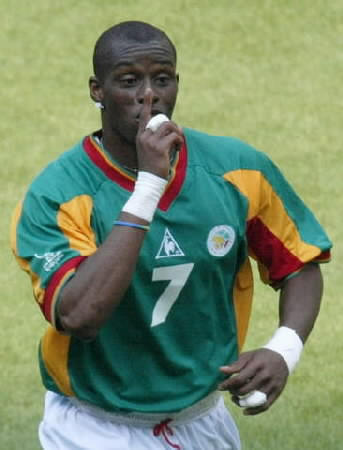
Footballer of the week - Henri Camara

Posted at 16:57 by tom in Football , Tom | | Comments (0)

henri-camara.jpgWeek 2 - starting 6th of February
This week my footballer of the week is Henri Camara. Camara, a Senegal international with over 50 caps signed for Saints on the last day of the January transfer window. He has done superbly so far scoring 2 goals in 1 and a half appearances. He is only on loan at the moment, from Wolves. Whether Saints stay up or not will probably depend if he wants to stay at the end of his loan. Last year when Wolves were relegated he refused to play for them. He was immediately loaned out to Celtic where he struggled to get in the first team behind John Hartson and Chris Sutton. At the end of his loan he went on loan again to Saints. He is not just a superb goalscorer he is one of the fastest and most skilful players in the Premiership.

February 06, 2005

Gallipoli 1: Prelude

Posted at 21:30 by tony in Gallipoli , Tony | Trackbacks (2) | Comments (0)

The reasons for the Gallipoli Campaign were rooted in the events of 1914 and, like many, if not most, my family were involved. It may seem self-indulgent to concentrate attention on one battalion and one family, but a true picture of war needs a close up look at the effects on individuals as well a the wide angle view of large armies on the move. The hope is that those individuals may in some measure represent the experience of those who are otherwise ignored.

As it happens, my mother’s brother, Arthur Flemming, passed through Stretton [Stretton on Dunsmore, the village where Tony lives] on the day war started. He left a diary and told how on that day he was cycling from Coventry to London. He took shelter from the rain under a railway bridge and was told the news of war’s outbreak by other shelterers. He was a reservist with the 3rd Coldstream battalion and within a few days was at the front near Mons. And, as a corporal in charge of a machine gun unit, he was deeply engaged in ferocious battle within three weeks.

Those first engagements of the war brought the military theories of three nations into bloody conflict with the new nature of modern war and hundreds of thousands died because of the gap between theory and reality.

The French climbed the learning curve at greatest cost. Before the war, their military theorists had forcefully taught that only aggressive spirit won wars: imprudence became a virtue. This was the doctrine of offensive à outrance. It reckoned not with the new reality of machine guns and barbed wire: the balance had shifted firmly in favour of the defensive. About four hundred thousand Frenchmen lost their lives in reckless attacks in those early weeks. Colonel de Grandmaison had done for them all with his plan of attack.

The German Schlieffen Plan embodied a less extreme version of the same concept. It envisaged a powerful right hook by two strong armies, passing through the part of the front held by the British, leading to the envelopment of Paris and a swift conclusion of the War. The British army – “contemptible” was the Kaiser’s word – was not held in high regard; it was thought that they had shown a lack of rifle skill against Boer farmers a decade or so earlier.

In the event, chance and practice favoured the British. Their allocated role at Mons was defensive, which was fortunate. And, precisely because of the lesson learned from the Boers, they had practised formidable rifle skills. Fifteen rounds a minute was the claim. Now, if you have ever operated the Lee Enfield 303, you will know that this is a supreme claim: up with bolt to gather the cartridge; forward to push it into the barrel; aim; take up finger pressure; fire; bolt back to eject cartridge case; bolt down to collect the next cartridge. All in 4 seconds.

Germans have testified to this murderous firepower. At Mons, the mass of grey uniforms met British bullets and recoiled. Many believed that each British soldier was equipped with a machine gun.

But at the same time the French, on the British right, were recoiling, badly mauled from their frustrated attacks. As they retreated, they left the British flanks unprotected so the British, in their turn, had to retreat. Thus began the Retreat from Mons: days of hard marching, interspersed with fierce fighting engagements, costly to both sides.

When war was declared, there had been wild cheering in the streets of London, Berlin and Paris. Not quite everyone. Lord Esher, who was to prove consistently prescient about Churchill and Gallipoli, wrote on 27th August that London Society tended to regard war as “a sort of picnic, chequered by untoward incident, but there will come a day when the flower of our manhood will have been gathered by the reaper, and when the casualty lists will contain nothing but plebian names that convey nothing to anyone beyond the mourners in obscure homes.”

Two days later, Arthur Flemming recorded just such an untoward incident. The Guards Division, dog-tired and foot-weary, paused to rest for the night at Landrecies. They were suddenly pulled from their rest by an urgent alarm when the small town was attacked by German cavalry. Arthur’s machine gun was set up in the main approach road and they became part of a fierce close engagement, with hastily erected barricades of carts and wagons, weirdly illuminated by the light of a burning haystack. The fighting went on till early morning when the Germans withdrew, leaving 800 dead and a badly damaged 3rd Coldstream battalion. The High Command distinguished themselves less well: Haig, the Corps Commander, sent a panicky call for help to GHQ, which caused one general to faint.

However, the German advance was no victorious strut. Thirty-two days from Mons to Marne took their toll. Their ragged, dust-covered soldiers, with boots worn thin, were suffering. And their commanders were having to face the fact that retreating French and British armies, far from being annihilated, were withdrawing in good order, powers of resistance intact, while they themselves were outrunning supply trains. The critical Battle of the Marne was about to test both sides.

If the Allied position was still precarious, the odds were changing in their favour. And in Joffre they found the man for the hour. The counter attack he organised, after days of fierce but indecisive conflict, eventually turned retreaters into advancers, advancers into retreaters. And those on both sides have recorded the profound change in morale in both armies.

Roles were now reversed. The Germans retreated to prepared defensive positions north of the River Aisne. The Allies advanced, only to be checked by the German static defences. It was the end of the short period of mobile warfare. Each side tried to outflank the other; each failed. And the line was extended until mutually repelling static defences stretched from the Alps to the English Channel.

There was still to be a time of crisis in October, before Ypres, when the Germans almost achieved breakthrough. And there, as it happened, another of my mother’s brothers, Alf Flemming, was involved in an episode of high drama, which cost him his life.

The situation was roughly as follows. The High Command of both sides still entertained unreal pipedreams of breakthrough. The ancient textile town of Ypres, an important road junction, was the key to the northern front. From Ypres, the Menin road led to the front through the village of Gheluvelt, about five miles away. Between the two was Hooge Chateau, divisional HQ. Breakthrough at Gheluvelt was a prize that could have allowed the Germans to outflank the entire British army and open the way to the Channel Ports.

In late October, a series of attacks were resisted at high cost to both sides. On the morning of the 31st, the Germans launched a massive attack with seven fresh divisions and Gheluvelt fell. One of those involved on the German side was Adolf Hitler, who had had received his baptism of fire on the Menin Road two days before. That same day, a shell hit Chateau Hooge HQ. The Commander in Chief, Sir John French, looked disaster in the face and wrote later that it was the worst half hour of his life. Haig prepared orders for retirement.

In the afternoon, 1st S. Wales Borderers had counter attacked, regaining a small part of the old position. Their position was precarious, with small chance of holding on without reinforcement.

And reinforcements there were none. No reserves left, except for one depleted battalion of 2nd Worcesters. About 350 men, a third of full strength.

It was enough. Led by Major Hankey, the Worcesters moved up and put in a charge over a thousand yards of open ground. This caught the Germans relaxing after success and drove them off. It is one of the most celebrated actions of the entire War and Sir John French said that on that day 2nd Worcesters saved the Empire.

Not without cost. More than half those in the charge were casualties. Alf Flemming died of wounds in German hands the next day. He left a young wife and infant son.

There was a strange postscript. Some time later, Alf’s wife received a letter of condolence from a German soldier, which said – when they had found someone to translate it – that Alf had died in his arms.

That day, for those with the wit to realise it, signalled the end of the dream of breakthrough, although the lesson was slow to be learned by some in command and many paid with their lives for such mental rigidity. Machine gun and barbed wire between them left only the prospect of stalemate and endless indecisive trench warfare.

The Christmas of 1914 is remembered for the account of Germans and British playing football in a Christmas truce. Arthur read of this and recorded: “Not in our part of the line they didn’t. And it would have gone hard with them if they had tried”. There had been casualties the day before and, on Christmas day, a day of hard frost, when a few Germans put their heads up and shouted “Merry Christmas!” they were immediately shot at and sniping back and forth went on all day. One of the Guardsmen wounded that day was Captain Edward George Spencer Churchill. Surely some relative of Winston’s?

And Winston was one of the few to give deep thought to the new military problem. He was looking for some alternative to what he described as sending the new armies “to chew barbed wire”. The Gallipoli campaign was the result.

A future prime minister and Churchill’s deputy during WW2, Clement Attlee, who fought at Gallipoli, once described Churchill as half genius, half fool. The astute Lord Esher said he was “bold and fertile, but wild and impractical”. A.G.Gardner, in 1912, said:

He is always unconsciously playing a part – a heroic part. And he is himself his most astonished spectator. He sees himself moving through the smoke of battle – triumphant, terrible, his brow clothed in thunder, his legions looking to him for victory, and not looking in vain… In the theatre of his mind it is always the hour of fate and the crack of dawn.
These characteristics were to be stamped on the Gallipoli campaign.

An outrage against simple men

Posted at 21:20 by rob in Gallipoli , Rob | Trackbacks (112) | Comments (1)

This evening I will begin publishing a series of articles written by my Dad, Tony Jordan, a history of the Gallipoli campaign of 1915. It's a very personal account: Dad's father miraculously survived one of the bloodiest landings of this initiative, unlike the majority of his companions, who were mown down in minutes. The tale of intertwined lives is as fascinating as it is horrific: Churchill, the architect of the botched mission; Robert Jordan, a foot-soldier in the Royal Munster Fusiliers; and a young officer named Nightingale, the uncomfortable interface between Whitehall's strategy and the grim reality of a Turkish beach.

I'm very grateful to my Dad for writing this and for allowing me to read and publish it, and also to my old history teacher Chris Holland, for giving Dad the impetus to turn decades of study into a finished article.

February 05, 2005

Thank God that's over

Posted at 2:22 by rob in Rob , Technology | Trackbacks (1) | Comments (0)

If you're reading this, there's a good chance that our migration to a new web host has completed successfully. Though not without incident. I clumsily deleted all articles during the transition, and had to reconstitute from various bits of backup, here, there and everywhere. For a while our About page pointed to a story about Space Aliens, curiously appropriate especially after an all-night session to repair the mess I'd created. If I were Jerry Pournelle of Computing at Chaos Manor fame, I'd tell you all the gory details, but I'm not, so I won't.

Normal service should now be resumed.